Joe Brazil Interviews Al McKibbon

November 1, 1974

Joe Brazil: It appears to see if this is working. Probably. This tape is possibly bad. Or it is possible that the microphone or some other mechanism was not working right. 

We expect to have Mr. Al McKibbon. We made an announcement… I made an announcement about the review and everything so great. 

Let’s talk about some of the players that you have been listening to, some possibilities. 

These are lecture notes.

I was a little late today, but I think it was well worth our while. One of the finest musicians in the world happened to be touring in town with the Sammy Davis group agreed to come out and just chat with you. Something about the history of the music. I won’t go into it in too much detail because we want to try to use as much time as we can for him to lecture and discuss something about the music. This bass player, he was around during the Charlie Parker era, the Forties. He played with Dizzy Gillespie, “Lucky” Millinder, Coleman Hawkins, Count Basie, four or five years with George Shearing, many, many others. How about a nice hand for Mr. Al McKibbon?

[Applause]

We’re just going to kind of keep it loose. I don’t know if any of you might… he’s actually from Detroit and I feel kind of very close to him. Went to Cass Tech. What’s up?

Al McKibbon: Cass Tech was a school, only a high school, but very technical. They had a… they furnished instruments for as many as a hundred-piece orchestra plus concert band. The curriculum was that you must have academics plus whatever your major was in music. Also, four terms of piano was required. And of course within all that they had jazz orchestras and choruses and all that. I think it was one of the most complete high schools I’ve ever found in the world. 

A lot of people came out of the school, like Joe Brazil, Lucky Thompson, Milt Jackson, Howard McGee… Huh, I can’t think of many of them right now. Teddy Edwards. You name it. Quite a few. Wardell Gray. Maybe some people you don’t even remember. They were active back in the forties. Did you know any of them? [Laughter] You know Milt Jackson, right? 

So anyhow, I went to that school. Of course I had to study after that privately. I studied with Mr. [Herman] Reinshagen who was 36-year principal bass with the New York Philharmonic. I studied with him in California where I now live. 

After leaving Detroit I went to New York City with… well they needed musicians very bad at that time. It was war time so I got a lucky break with “Lucky” Millinder. And after that went to 52nd street and worked with Coleman Hawkins and Charlie Parker and all those people current at that time. 

And then after that I started to think about the money, so I went with Jazz at the Philharmonic. And after that it was CafĂ© Society downtown in New York City and made a European tour with Dizzy Gillespie. I played with Miles Davis’ first group, Thelonious Monk’s small group, and then I really went for the money and started working with George Shearing. People say, “How can you play with a small group like George Shearing after all the hard jazz you’ve been playing, versus with Dizzy’s big band where we would play Manteca and Things to Come, One Bass Hit, all those things. How can you play with a small group like George Shearing and be happy?” Well I said, “Because George Shearing, at that time, pays more money than all those other people.” 

I realized to go through Florence, Ohio and visit my brother and he said, “Al, you didn’t win the jazz poll this year.” I said, “Well, no I didn’t win the jazz poll but the winner of the jazz poll is not working. [Laughter] 

So, you know, I believe if you put a lot of time in whatever you’re studying, you should get paid for it. I think it’s a shame that the symphony orchestras of the day, make less money than I make playing behind Sammy Davis Jr. That’s ridiculous. There’s people spending a lifetime studying an instrument to become proficient and top of their fields and to have to go through rigorous auditions and keep up on current libraries and all that, and they make less money than I do. That’s a sad commentary on the state of the arts. 

In the meantime I’m trying to have fun and here I am so I would like to answer questions if you’d like to ask some. 

Male voice: Could you go into more detail about 52nd street and how it was down there.

AM: More detail? Well on 52nd street there was a block of clubs that were only basements of tenement houses converted into small one room nightclubs. They were pretty dingy, actually. But the people who owned them, knew of the wealth of jazz musicians in New York City at that time. It was war-time. And New York at the time was the mecca of all jazz musicians so they would just get… oh I remember it, one time there was Dizzy Gillespie and Charlie Parker at the 3 Deuces. Next door at the Downbeat was Billy Holliday, Art Tatum, and um… the group I was playing with I don’t remember. [Laughter] Next to that was the Spotlite club with Dizzy’s big band and there was always two or three groups in each so all the musicians would play their little set, then run next door and see what those people were doing. Of course, Dizzy Gillespie and Charlie Parker had everybody in front of their place. On the other side of the street they had a couple of Dixieland clubs that I wasn’t too thrilled about. They had the best Dixieland music. And one jazz spot that featured vocalists, usually. 

But 52nd street was kind of a way of life until the underworld move in and always moves musicians out. Whenever they come in with the pushers and whatever, then music goes out the back door because people become afraid to frequent the places with the freedom they used to exercise. So 52nd street had to go the way of all places. It just became notorious because of outsiders, not because of the music. The music was always excellent. 

Female voice: Do you have any remembrances of Billie Holiday?

AM: Ha. Yes. I knew Billie Holiday. I used to call her William because her name was Billie. Ahh… Billie Holiday was… ahh… quite… she was nothing like the movie. Nothing at all like the movie.

FV: How about her book?

AM: Her book? Well the book was fairly true. But, you know, there are so many things that are just better unsaid about a person’s personal life and she didn’t put all those things in the book. And the movie was just a vehicle for Diana Ross, more or less. Because Billie Holiday was a pretty plump lady with a hell of a feeling for jazz and very soulful and very hung up on narcotics, uh, bisexual, and a very strong lady. 

In fact she used to scare me to death, you know. She said uh, she could never remember my name, she said, “Hey, bass. I saw you last night with your missus. How come you didn’t speak? Are you afraid I’d get fresh with your missus?” Well, that’s the kind of lady she was. [Laughter] 

Yeah, you know? Well, you asked me. I’m just telling you. Nothing at all… [Laughter] Nothing at all like to movie. You know? In fact, uh, they were afraid to sell drinks whenever she was on stage. But when she started to sing you wouldn’t want a drink any how because she had the gardenia and her eyes almost closed, you know, and she would be singing those songs, you know, and she’d cast a spell. She’d really… 

The best way to listen to Billie Holiday is get the early records because they started to take advantage of her bad name when they put out the late records and her voice was through. She was done. Ankles were swollen, elbows, and she… Boy, she was just through. She was just hanging on by a thread. And, uh, the police used to just follow her around to shake her down, you know? Since she was kind of miserable near the end of her career. But one of the best singers ever.

Male voice: What’s the walking bass style?

AM: What is it?

MV: Yeah. What does it sound like?

AM: Well, ah… you know, as we call, what we call jazz, always gets labels that, ah, come from people that have nothing to do with it, as a rule, you know. So they, it’s just an old expression that when the bass was really playing a good strong rhythm they would say, “Hey, he’s walking.” It’s not really anything in particular. Just means to play a good rhythm with a good line.

MV: Where does the term, “Taking a ‘Boston’ come from?”

AM: You know, I don’t know. That’s a little too old for me. [laughter] But I have heard that. I heard it from older musicians. They say, uh, “Take a ‘Boston,’” which meant, “Play an ad lib solo.” But I think it was a very old expression that was used by earlier musicians.

MV: Two questions. Who is your inspiration and where is Sammy [Davis] playing? I haven’t heard anything about it.

AM: Sammy is at the Paramount Theater. We’re doing two shows tonight. Did one last night. Two tonight and then we’re going to Portland. 

And my inspirations came from quite a few people. In Detroit, my hometown, there was a dance every Monday night at the Graystone Ballroom that had all the big-name bands. And it was a big dance town and I was always very tall so I could get in when I was very young. I would stand in front of the bandstand, my mouth open, you know? 

And I saw, oh, gee, I saw Wellman Braud, used to be Duke Ellington’s original bass player. And I always admired his volume and tone. So I, kind of, listened to that. And I listened to Pops Foster. And then, after I learned to play like Walter Page, he was Count Basie’s original bass player, I heard Jimmy Blanton, and started to chop up my bass and throw it away. [laughter] Because he, ah, he… he was the first not to play a walking, as they call it, bass style. When it came to his solo, he would play like a horn. So when I first heard that, it turned me completely around. This young kid was only about, oh, 19 years old and already playing with Duke Ellington, you know. Featured with Duke Ellington. Well that’s quite a thing.

MV: Do you play a stand-up bass or an amplified bass?

AM: I play them both. Yeah, well, you know, these days, the stand-up bass is still being used but, if you want to make money, you have to play them both. And I really want to make some money, man. [laughter] I don’t want to be here forever. Really, you know. When it gets so that bass is heavy, well then… Like, I don’t stand and play anymore. I sit down. That’s a sign of something. I don’t know what it is. [laughter] 

MV: I believe you were a member of the Giants of Jazz group with the Jazz at the Philharmonic.

AM: Yeah.

MW: You were connected to… like, what’s the history behind how to get this young super group together?

AM: Well, they make you an offer you can’t refuse. [laughter] 

You see, the Giants of Jazz… I did a world tour three years ago, but, ah, Dizzy Gillespie, Sonny Stitt, Art Blakey, Thelonious Monk, Kai Winding – trombone, and we travelled around the world doing jazz concerts for George Wein, who’s, ah, the Newport Jazz outfit. And so, I live in Hollywood and I was just out there doing studio work because I don’t want to travel anymore. But he called me and asked me if I could make the tour and I said, “Well, I really don’t want to travel anymore, George.” And he said, “Well, I’ll pay you…” and I said, “You’ve got me.” [laughter] It was that simple. 

Same way with… Norman Granz used to be a disk jockey in Los Angeles before he started Jazz at the Philharmonic. And he started doing some concerts locally. And they became so popular that he became international. In fact, he lives in Switzerland now. With his bank roll that he’s made off us musicians. By paying us weakly – w-e-a-k-l-y, [laughter] he’s made his bank roll and has retired. But he’s been a great influence and supporter of jazz. I must say that about him.

MV: Don’t forget his new label, Pablo. Are you doing anything with that?

AM: No.

MV: Of the guys you played with, who did you enjoy playing with the most?

AM: Dizzy Gillespie.

MV: Why is that?

AM: Dizzy Gillespie? Well, when I was in his big band in 1948, we had people in the band like James Moody, and, oh, so many people who became stars after that. And Dizzy would come on the bandstand and he would warm up his horn. He would say, “What do you guys want to play?” Well, God! How can you not like working for a guy like that, you know? [laughter] He would say, “What do you guys want to play?” And then he would out play everybody. [laughter] 

Well, you know, Dizzy Gillespie, whoever named him was really farsighted because he is… We were playing a small band concert in Paris in, ah, matinee. And we were on a little stage with a curtain. So we played in the ensemble and after the ensemble was a saxophone solo, naturally. So Dizzy stepped behind the curtains, you know. 

And we kept playing and playing and playing. Say, “What the… why, why this guy doesn’t come out. Let’s finish the tune. So I looked back behind the curtain. He’s back there making love to some girl. [laughter] It’s time for him to play the chorus and go out. He’s back there smooching. [laughter] Come on! So that’s why, you know, I think I enjoyed working with him more than anyone. [laughter] Not because of the smooching. No. 

But, you know, ah, not only that, but Dizzy, is from Cheraw, um, North Carolina, South, South Carolina, and he, uh, he took the band once to that little school he used to go to. And when you see what a background he came from, you can appreciate what a tremendous talent this man has. He’s not only… You know, had Dizzy been another type of person, I think he would be a retired millionaire. He came along with an entire new style of trumpet playing, a new style of dressing, a new style of talking, acting… You know, people ask me, “What was that music you guys are playing?” He said, “Bebop.” Which means nothing. [laughter] But he, that’s just his style. He said, “Bebop,” so that was it. 

So he, uh… Right now, I think Dizzy Gillespie is one of the greatest stylists, trumpet players, innovators in jazz. And he has his ears completely open to anything that’s going on. Everything that’s going on. 

Except what Miles Davis is playing right now, which, I don’t know what that is either. [chuckles] But, uh, we saw Miles in Berlin and Dizzy said, “Miles, I wanna… I’d really like to understand what that is that you people are playing there. Can you explain it to me?” 

So Miles said, “Hit ‘C’ over there on the piano.” 

So Dizzy hit the “C”. 

“Bong.” 

He said, “Now forget about that!” [laughter] “Think about all those other notes you can play on top of that.” 

I said, “Well…” [laughter] 

You know, so, ha, I like all kinds of music but, uh, that’s a little strong. And when you have to have a whole bank of electronics behind you in order to play, I think that takes so much from it. That takes almost all of it for me because, you know, in the older days when you wanted to make a louder sound, you played harder. If you wanted to make a round sound, you used your best technique. If you wanted to make a quick sound, you did it yourself. 

But now, if you want to change anything, you flick a switch. So I think, after a while they’re going to program everything, you know? And you say, “Come to see the Moog synthesizer,” you know, and you just sit out there and the man presses a button and, you know, you’ll hear the music and see the picture and everything. And then we’re all going to be out of work. [laughter] It’s going to be all over. 

Oh, I want to say about rock music now. Ha. I like rock music, when it’s good, musical, and has more than one chord. You know? [laughter] Yeah, I like that. I like that. That’s very good, you know? Sometimes it has tremendous pulse and people can get out and dance, you know? And all that. I think that’s marvelous. And I think it’s all part of our heritage because it’s simple rock and roll or rhythm and blues or whatever. 

You know, I think that’s a, that’s kind of pitiful, too. I remember when they had jukeboxes, they had three columns of music. They had race music, which was rock and roll, and pop, and country. And now it’s all one. And anybody who can play one chord on a guitar can get a group together, the Three Monkeys, you know? [laughter] Yeah. And make five times as much money as a symphony orchestra. You know? I think that’s pretty bad.

JB: Is there any more questions?

[bell rings]

AM: Who are they? Aw, man, they got some, woo-hoo, Stan Clarke and Ron Carter and uh, Rufus Reid or Richard Davis, my friend, yeah.

MV: Let’s have a nice hand for Al McKibbon. 

[applause]

AM: Thank you.

JB: So you can catch him tonight, folks said you can catch him at the Paramount Theater with Sammy Davis’ group.

[talking as class leaves]

Female voice: Thank you for coming to talk to our class.

Out of this World: John Coltrane in Seattle

by Keith Raether

Published in Earshot Jazz, April 1995, Vol. 11, No. 4

Late in the morning on Oct. 1, 1965, drummer Elvin Jones was rummaging through Jan Kurtis' kitchen in Lynnwood, banging on cast iron skillets, tapping on stainless steel pans. Searching for a new sound. Saxophonist John Coltrane sat quietly at the kitchen table, interrupting his inner focus only to smile at Jones or talk about song charts. Saxophonist Pharoah Sanders, pianist McCoy Tyner, bassists Jimmy Garrison and Donald Rafael Garrett -- the rest of Coltrane's band on a West Coast tour that began in San Francisco -- listened with purpose. Seattle saxophonist Joe Brazil completed the circle.

"Coltrane seemed to be thinking about a lot of things," says Kurtis, 30 years after he recorded Coltrane's seminal Live in Seattle double album and the otherworldly Om later released on Impulse Records. "There must have been an enormous amount of music going on inside of him."

Jones, meanwhile, had a cosmos of sound evolving around him. When he wasn't playing pots and pans like a sock cymbal, he was filling soda bottles with water, testing them for timbre. Coltrane had come to Seattle the previous day with his working band, augmented from the usual quartet by Sanders and Garrett, to play a two-night engagement at the Penthouse in Pioneer Square. Kurtis took the call to record the group.

"I was doing a lot of remote recording at the time," he remembers. And Coltrane was doing even more experimenting. In 1965 the saxophonist recorded at a prolific rate, as if he had received a divine calling. Ascension, recorded in June, broke new ground. The musical conception came to Coltrane in a dream, a dream in which he and his group played without reference to chords or chordal sequences. Within the music Coltrane set up dialogues of tonal and atonal sections similar to the parallel octave passages found in African vocal music.

Saxophonist Marion Brown, one of the players on the date, described the session as "wildly exciting." "We did two takes and both had that kind of thing in them that makes people scream," he said. "The people in the studio were screaming." Just as Coltrane and company would scream, literally, on the night they recorded Live in Seattle...

Sun Ship, a quartet album, followed Ascension in August. Between the two recording dates Coltranes' group traveled to the south of France for the Antibes Jazz Festival in Juan-Les-Pins. Coltrane was clearly searching for new sound, sound that would convey the vastness of the universe inside him. "I don't think I'll know what's missing from my playing until I find it, if you understand me," he told a writer for Melody Maker at the time.

Such was Coltrane's state of mind and music when he brought his group to Seattle in late September. He had turned 39 a week before he arrived. He'd thought long and hard about the composition of the band, and now Sanders and Garrett, old friends based in the Bay Area, were with him to intensify both ends of the musical spectrum. He'd thought about time, in the abstract and in the context of his group. Maybe the music needed to be free of meter. Maybe he needed to do away with the harmonic moorings of a piano. He had miles to go before he slept.

Kurtis, whose true musical interests were in Nashville, didn't know Coltrane from Bobby Goldsboro when he got the call to engineer the Penthouse date. But he knew a world about recording and brought the better part of his recording studio, Camelot, to the Pioneer Square club. "I think it was Bob Friede of KRAB-FM who contacted me about the recording -- 30 years is a lot of water under the bridge," he says. "I didn't know anything about Coltrane's music. And I certainly didn't know then how groundbreaking it was."

Kurtis lent his best recording equipment to the cause: an Ampex 350-2 tape recorder, two Ampex six-channel mixers, two Sony condensor mikes for Jones' drums and a large-diaphragm mike for Garrison's bass. "Everybody in the group had at least one mike," he says. "It was a studio setup for the most part. There wasn't a lot of live recording being done like that back then. I wanted to go all out."

On an emerald night in Seattle, Coltrane's group responded in kind. "Evolution" unfolded for 36 minutes, filling the better part of two sides of the original double album. "Body and Soul" and "Afro-Blue," traditional by comparison (and released for the first time on the new GRP reissue of Live in Seattle) were stretched light years beyond their limits. "Cosmos" demonstrated that Sanders was very much a "free" player and a perfect match for Coltrane at the time. "Out of This World," a serene, long-line ballad by Harold Arlen (from the 1945 film), first recorded by Coltrane in 1962, reached so far toward Andromeda that Kurtis didn't recognize it from the opening theme.

Coltrane was anxious to hear the playback of the tape and spent the rest of the night with headphones on. He was so impressed with the technical quality of the recording ("The tape was incredibly clear," says Kurtis) that he asked to come out to Camelot the following day. Kurtis had just finished converting the building next to his Lynnwood house into the Seattle equivalent of Rudy Van Gelder's studio in Englewood Cliffs, N.J. He was more than happy to oblige."

I was in my late 20's at the time, and it was all I could do just to concentrate on getting the mike setups right," he remembers. "Of the band, I remember Elvin most of all. When he found out I was a drummer, he showed me some licks. I could never play them in a thousand years. He also tried to explain what the new music was all about."

Coltrane was pretty quiet all day but very friendly. Everybody in the group was friendly -- and very respectful of the place. There was a lot of work to be done in a short time, of course, and the band was busy trying out things before we started to record."

To prepare for what writer David Wild would later call "the cathartic, acid-etched' music on Om, Kurtis put Jones' drums behind barriers, or "splays," that absorbed his voluminous sound in three inches of insulation. Garrison and Garrett had their own "cubbyholes" for maximum clarity and resonance. Coltrane, Sanders, Tyner and Brazil, who played flute on the date, claimed the rest of the room as their universe.

"It was a remarkable experience just watching them work," says Kurtis. "I was in a kind of Oz. Coltrane didn't say a lot, but he was in control of everything the band was doing. They were so far ahead of the times."

The Om session began around noon with an incantation: "I the Oblation and I the Flame into which it is offered / I am the fire of the world and this world's mother and grandfather / I am Om Om Om Om Om Om! Om!" The music stopped six hours later but didn't end.

Two months after Om was made, Coltrane was at the Village Gate, leading a band that featured percussionist Rashied Ali in addition to Elvin Jones. It was the saxophonist's first experiment with a two-drummer format. On Nov. 23, he recorded Meditations in the company of both Ali and Jones. A few weeks later, Tyner and Jones left the band."

A musician like John shouldn't have to depend on piano all the time," Tyner would say later. "Sometimes the piano, as an orchestral instrument, can get in the way of a soloist, especially a horn player." Especially a horn player with the sound and singular purpose of Coltrane."

There is never any end," Coltrane told music writer Nat Hentoff after the Meditation recording. "There are always new sounds to imagine, new feelings to get at. And always, there is the need to keep purifying these feelings and sounds so that we can really see what we've discovered in its pure state. So that we can see more and more clearly what we are. In that way, we can give to those who listen to the essence, the best of what we are."

For two days in Seattle 30 years ago, Coltrane didn't stop at giving us the best of what he was at the time. He gave us a glimpse of the musical universe to come.

Joe Brazil Interviews McCoy Tyner

Joe Brazil with McCoy Tyner
November 22, 1971

McCoy Tyner: [Plays] That’s what I was saying. Lots of the things we used to play. We didn’t really discuss things. [Laughter] That’s why it’s so hard for me now to talk about it. We didn’t talk about music. We just played. [Laughter].

Joe Brazil: Would he by any chance run down the cycle of what he was doing? Or did he just do it?

MT: Except for Giant Steps. You know. He would say, “I’m playing the cycle of fifths.” After a while he just stopped playing that.

JB: What about some other stuff like Body and Soul?

MT: That was a set… he had written out certain chords, set chords, for that, alternate chords. He fit the cycle there, the cycle of fifths in there, that’s why they got in there.

JB: He kept developing. Like when you heard, what was the tune that was a big hit? Favorite Things. On the original record, and then I heard it in Seattle and you know [laughs] it had developed.

MT: Yeah. I understand. You see that wasn’t… We didn’t… See that’s what I’m talking about. That’s why it’s so hard. I can’t really… I don’t think it’s really important to explain it. Because you can’t. All I know is that my ear developed to a point, playing with him…

JB: Of course. I guess it’s like a reciprocal thing.

MT: Years ago, cats could say I’m breaking down this, breaking down that, playing this and playing that. It’s not like that.

JB: That’s what I was bringing up. I don’t think it could be defined.

MT: It can’t be defined. I don’t know. Maybe we should get that on tape.

JB: Ok. [Laughter. Tape turns off and on]

MT: …Miles and the flat five…Dizzy came out with that type of thing.

JB: Like Woody ‘n’ You?

MT: [plays chords from Woody ‘n’ You] And during that time there was a certain, everybody played a certain type of way.

JB: What if you’re teaching a cat? Like you say your teaching cats in New York. Say if you were teaching a cat that was maybe developed a little bit. What would be your approach of teaching him then?

MT: Well, you see, most of these kids aren’t taught.

JB: Beginners, yeah.

MT: Some of them weren’t but they didn’t know a lot of the fundamental things.

JB: Then it’s a basic thing – scales, see what notes, what finger to use.

MT: The only thing I could really do would be to maybe show them how certain chords can go against another. Something like that. And the scale relationship to the chords. So they wouldn’t have to be limited to playing within the chord, necessarily, but using the chord itself as a pedal to launch off on to something else.

JB: Well maybe we could benefit by something like that. [Laughter]

MT: [plays chords over a G pedal] Like if I play G minor… this is one thing I was doing when I was working with John, is that each note of the scale could be a chord.

JB: Right.

MT: You could use each note of the scale and develop as a chord or a sound. In G minor, for instance, you have [plays] and you’ve got B-flat minor [plays]. B-flat minor could be a complete sound within itself. The G is still there. But you know where you started from. The B-flat minor is within that sound. All the notes of that particular scale is within that particular sound. So you are actually not wrong. You could get a G. [plays] See, it’s still there. C minor. [plays]

JB: It’s like planting that sound and then doing whatever that sound fits here.

MT: Yeah.

JB: You plant that sound and then it remains.

MT: Right. It’s all the way through. It’s like a… it’s something to launch yourself off. You launch yourself off that. See it still gives you the freedom to play within that sound. Because like, there’s a thing, like, if you start off like Jones used to play, boom-chick-boom, he played time, ding-ding-dink-a-ding-dink-a-ding. Nowadays they don’t play like that. When you start a tune off you know where the time is. We were playing off the pulse. Like it sounded like we were playing a lot of things that at the centers. Sounded like we were playing with no time. Well, actually, there wasn’t no ding-ding-ding, we were playing off like a pulse. You don’t walk to the sound of your heartbeat. Your heart says, “boomp, boomp.” You don’t say, “boomp, boomp” trying to keep up with your heartbeat. Your heart is beating at a rhythm and you are walking at another rhythm. It’s the same thing with playing music. Just because you are playing in a key, that doesn’t mean that you are limited to the key itself. There are so many things that are related to that particular key. It’s like I was saying in G minor, you look at a standard tune, the way it resolves, the natural resolution would be maybe to go to C minor. The reason they resolve is because C is part of the key itself. So are other notes.

JB: In other words, one is not more important than the others.

MT: Yeah.

JB: Like tonic is more important, but not necessarily.

MT: Yeah. All over music, they have established a drone or a certain thing. A drone. Like in Africa, the rhythms are the tone, you may start at any particular tone, or any particular key, or drone, then they would take that and everything else would happen on top of that. And you can take it as far as you want to go. As long as you know where you came from.

JB: So, if you were practicing. What would you sit down and practice? I mean, like, scales, or make up a cycle and then try to develop it?

MT: I don’t practice like that anymore.

JB: What would you practice like?

MT: Scales. When I do practice, I practice scales. Theory is good up to a point. After that… I’m saying it’s good to know it, it’s good to know how a brother’s approach to improvising, but up to a certain point, it’s a matter of what you hear and how you can develop it. It’s a matter of emotions. It’s a matter of knowing form. I may be playing in a different key and all of the sudden decide to go, according to my feelings, to a chord that’s maybe related to that key or maybe one that’s not related to that key.

JB: You know, the point I’m getting at is maybe somebody else may be hearing these same things but they don’t have the capabilities of doing it. You might feel like you want to go there, and do something very different, but then you haven’t gotten yourself developed to go there. You know?

MT: Well, that’s the thing.

JB: So how’s the guy going to develop?

MT: If he can hear, he’ll do it. It’s a matter of really playing your instrument well enough so that you can do what you can hear.

JB: That goes back to that other thing.

MT: Yeah. There’s a certain part, an area of music you can’t explain.

Unknown voice: It’s like a transition.

MT: Our music has never been a Western concept of explaining music.

JB: Yeah. Right. Right. [Laughter]

MT: Our music has never been like that – explained. Even in Indian music, they take a raga, they have 700 scales, 700 ragas, one for the morning, one for the evening. Sounds pretty restrictive. But then they take that raga and they work with it. In between the notes and everything like that. And they improvise, like all black peoples of the earth always improvise their music. We never sit down and systemize everything where it came from. That’s why I say it’s moved out of the realm of… see, what’s happening, I think it’s wrong to make a study, I mean when I say wrong, I think for musicians, if you’re trying to approach it from a teaching aspect, that’s different. I think for musicians to take it and study it to the point wherein they say, “This brother broke this chord up here so that’s the way it’s supposed to go. I know it was broke up that way so I’m going to stick with that.” [Laughter]

JB: It’s lazy.

MT: When you reach a certain point, it’s you, it’s the individual, and the individual effort.

JB: Has there been a point in your life where you practiced like 8-10 hours a day?

MT: Unh, unh.

JB: I mean, like, 4-5 hours a day consistently over a couple of years?

MT: No

JB: 4-5 years? You’ve gone beyond that now.

MT: Yeah.

JB: I think for cats to get control of their instrument, they got to go through that certain period of learning the instrument.

MT: That’s the way it is. Learning the instrument. That’s the whole idea. Otherwise you will be restricted to just playing a certain area.

JB: You can’t do something. If you have the idea, you can’t go there.

MT: That’s the whole idea is to learn the instrument well enough to go wherever you can hear. And by playing an instrument every day and practicing, you’ll go all the places, but you’ll get tired. Your facility will evolve to the point where you just, you’re not going to be satisfied with just going right here, playing within 2 octaves. You want to play maybe 2 or 3 octaves or something like that. You want to try some other direction. That’s the reason why I think a man like Bird, I heard that he knew what he was doing but he didn’t know what he was doing. He was playing like that since he was young. Somebody said, “Where did Bird develop?” He was playing like that ever since he was young. So apparently, he heard that. You see? He heard that. So what cats did, they made a study of Bird.

JB: Somebody will come along after him.

MT: Right. What I’m trying to say is that with him it was a spontaneous thing. It’s like, “Well, God, I don’t know how you can figure out what he did.” [Laughter] I’m trying to figure out myself. How I can some kind of way get it across verbally and think it’s almost impossible. It’s almost impossible because music is a language that is hard to… you just can’t communicate everything. Some think it’s like a religious experience. You can’t tell some person, “Man, I felt like this when I was communicating with God.” It’s just something that you have to experience. You can give a person an idea. But then the actual thing is…

JB: But you’ll know when you get there.

MT: Yeah. You’ll know it. I think that’s just the way it is. Yeah. I was thinking about that, Joe. It’s really a different approach, man. I don’t know if it’s different. I just think that… I guess it is different. It’s a supreme power. How can you, ah?

JB: You just got to experience it.

MT: You don’t want a guy to be limited to just what you’ve shown him.

JB: Right.

MT: Just what you’re doing. You want him to have the freedom to express himself. He might know technically what you’re doing. He might know what that chord is. But why you did, why you played that chord…

JB: At that time.

MT: At that time. See what I mean. Or why he decided to maybe play a part of it and mix it up with something else. He can’t explain why he decided to do that. It’s not a theory of when I’m going to hit a bulls-eye, I was resolving from here. [Laughter] It’s a thing where you are more of less functioning on a disparate level.

JB: When you can get yourself up that far.

MT: It’s a different level of awareness.

Unknown voice: Yeah. Like I guess you explained it. I was fooling around with a basketball. You mentioned how those cats can stand back there an make a basket and don’t touch the rim. I don’t think you can explain how he does that. If you could just get out book, damn! [Laughter]

MT: Maybe it’s a level that he developed that’s beyond explanation. That makes him do that. Maybe he’s got a science. That’s what it is. Music is a science. It’s a science, man. Cats out there can play musical scientist in many respects. That’s why I think music has been used in the past, it has been used in many capacities, and it is a form of worship. And also, it has been used to, it’s being used now in hospitals, in the past it has been used for many other things. What we call magic now a days. I think music can be used to stimulate people to do anything.

JB: Yeah. We were talking about Yusef and the black scientists and everything. But I bring up an analogy, sometimes it’s like, when a black musician is playing and he is creating spontaneously, he must be doing some tremendous things with the mind in order to be able to be performing, and thinking, and communicating all at once. When a cat is reading, he is just taking it off the thing. But he’s doing this right on the moment and he’s creating, he’s composing, and playing. That must take a great deal of intelligence in order to be able to do that.

MT: Well that’s what it is. It is an intelligence that is not used voluntarily. He’s not thinking about it. That’s the reason why I think we are natural scientists. I was surprised at electric pop, you know, meaning something as simple as that, a man doesn’t do that right there, anything you can think of, them being scientists, creating the sciences that had a hand in bringing about music. I don’t think any of us who studied on it… but I think a lot of it is natural. I think we are endowed with more knowledge than we actually realize. Like they say, “You can’t stop it. Genius. It comes out.” But we don’t believe it. [Laughter] You see, that’s the thing. A man may have knowledge but if he’s constantly told, “You don’t have none” then, you know, that’s something you’ve got to believe.

Unknown voice: One of you here told me black people were scared of jazz.

MT: Well, it’s a matter of proportion because it’s true. I think people are afraid of truth any flavor, any kind of truth, if they are not used to it, being exposed to it. If they want to live a false life. If it’s not true you’re only guessing. We need better ways that will dominate.

Unknown voice: That’s weird.

MT: I think we’re going through [unintelligible] and I think that sometimes something that may not be alien to you but because you have been misinformed or miseducated will turn you into saying, “That’s strange. I don’t dig that.” Some people who are ready for it will immediately react and say, “Let’s run this up.” A lot of the time I think we don’t realize how living in a society where we have been programmed on just about every angle. I know you all realize, but you go down to the music, playing certain music that people in a certain thing are thinking. There is a study, I think, I don’t know what [unintelligible] There is a study where different tunes affect certain parts of the body. Certain tones affect certain points of the body. There’s a science there. That’s the reason why people respond to certain things because it has like a physical, not only it’s physical but it’s sort of a spiritual and physical effect on them at the same time, certain notes or certain ways of playing.

JB: There’s a book I got called The Mysticism of Sound.

MT: Yeah. I haven’t had a chance to read it yet. You can’t delve into anything without getting into the spiritual aspects. Without spirit, the body wouldn’t live. That’s the whole thing. That’s what the key is. That’s the part of Him that’s in us that keeps us alive. When that goes, we just go away. Back to dust. [Laughter]

JB: We got to do that TV show early, 7:30 in the morning.
[tape ends]

[audio tape of TV show]
McCoy plays Search for Peace

Interview

McCoy plays Peresina (partial)

Joe Brazil: Justice for Joe

JOE BRAZIL: JUSTICE FOR JOE

I originally published this in the April 2012 issue of Earshot Jazz. Most of the facts were gleaned from the University of Washington Archives.

Attacking the Ivory Tower

A rally at the Husky Union Building on the University of Washington campus kicks off “Joe Brazil Day.”  On April 21, 1976, 350 people march to the University President’s Office and present a written demand – before May 5, an open meeting involving testimony from students, faculty, and community be held to officially grant or deny tenure to Assistant Music Professor Joe Brazil. Brazil, a saxophonist from Detroit who recorded with John Coltrane, teaches the History of Jazz, the most popular class in the School of Music. He frequently brings leading jazz artists to perform in class – Earl “Fatha” Hines, Dizzy Gillespie, McCoy Tyner, and many more.

“I’ll accept this,” says President John Hogness, “and I’ll have an answer.” Ed Woodley, head of the Black Student Union isn’t satisfied. “We’re tired of waiting and getting no answers.” The protesters head for their next stop.

Behind locked doors, police guard the Music Building. Five uniformed officers secure the west door, eight at the north, and ten at the east. More strolled through the corridors. Classes were cancelled. Outside, the crowd chants “Justice for Joe!”

Brazil had been denied tenure by the School of Music faculty during the previous school year. No public notice of the meeting was given and no minutes had been taken. Protestors believed this procedure violated the Open Meetings Act enacted in 1971 by the Washington State Legislature.

“It’s unfortunate it had to come to this,” says Brazil. “Hopefully people came here to learn.” Brazil is not vengeful. He tells the crowd that many of the people voting against his tenure are “just dumb, not mean.”

The Detroit Jazz Scene

Joseph Brazil was born in Detroit on August 25, 1927. He studied saxophone at the Detroit Institute of Music and Conservatory of Music. After graduating from Cass Technical High School in 1946, he joined the US Army and was stationed for a year at Geiger Field near Spokane, Washington. There, he performed in a band with other enlisted men. They called themselves the G.I. Jazzmen of Geiger Field.

Brazil returned to Detroit and got a job at Chrysler as a tool maker and inspector. He purchased a home with one of his brothers and outfitted the basement with a bar, baby grand piano, and chess boards. Soon, talented local musicians and touring artists crowded into the small room to jam. Visitors included trumpeter Donald Byrd, saxophonist Sonny Red, pianist Barry Harris, bassist Doug Watkins, and drummer Roy Brooks. When saxophonist John Coltrane was in town in September of 1958, he stopped by to jam with Joe Henderson and Brazil. A recording from the session is available on YouTube. The tempo on “Sweet Georgia Brown” is clocked at a blistering 350 beats per minute. Brazil made many recordings at his house, even Coltrane practicing.

Detroit jazz chronicler Jim Gallert interviewed musicians about Brazil’s jams. “Everybody you can name used to come by those sessions,” recalls drummer Bert Myrick in Before Motown. “I talked to Trane for about an hour, sitting on the basement steps.” Brazil made a space where a community of jazz artists could hang out, learn, play, and build relationships free from commercial constraints.

Brazil and Coltrane established a lasting relationship. In Alice Coltrane’s biography Monument Eternal, pianist Kenneth Cox says that Alice McLeod met her future husband John Coltrane in Brazil’s basement.

Brazil in Seattle

Brazil got a tool making job at Boeing and moved to Seattle in September of 1961. Two years later he enrolled at the University of Washington to study math and computer programming. He got a job as a mechanical technician at the UW Applied Physics Lab in 1965 and was promoted to a computer programming job in 1967.

Meanwhile, Brazil made a splash on the local music scene. He gigged at the Seattle World’s Fair, appeared with trumpeter Webster Young at the Red Rooster, singer Woody Woodhouse at the Mardi Gras, bassist Rufus Reid at the Checkmate, saxophonist Charles Lloyd at Seward Park, and led the house band at the Penthouse with pianist Jerry Gray, bassist Chuck Metcalf, and drummer George Griffin. The Penthouse band played Saturday afternoon matinee sets before national touring acts.

One notable group came to the Penthouse the last week of September in 1965. Coltrane was touring after the release of his award winning album A Love Supreme.  The band stayed at the Frye Hotel but Coltrane spent the week at Brazil’s house. Coltrane was interested in documenting the new direction of his ensemble so he paid out of his own pocket for a live recording at the Penthouse and a studio session in Lynnwood. Brazil sat in on saxophone at the Penthouse and played flute in the studio. The live recording was released as Live in Seattle and the studio date as Om.

Brazil began to dedicate himself to sharing music with young students and using his extensive network of musical relationships to connect interested students with mature artists. In 1968 Garfield High School initiated a “magnet” program which included fine-arts curricula. Brazil was hired to teach jazz. Also, Brazil taught in the Summer Emphasis on Education and Knowledge (SEEK) program at Garfield. He also headed the music program for the Seattle Public Schools Extended Services Program (ESP).

Brazil joined a steering committee of black leaders to address issues of justice, schools, jobs, community education, racism, economics, and political power. He founded the Black Academy of Music “dedicated to uplifting the consciousness of people through music.” Faculty included trumpeter Floyd Standifer, saxophonist Jabbo Ward, and bassist Milt Garred. Brazil raised funds to bring saxophonist Joe Henderson to Washington prisons. One of Brazil’s students, Gary Hammon, received one of the first scholarships to attend the New England Conservatory.

Jazz Studies in Academia

The Civil Rights Act of 1965 and the Black Power movement led white universities throughout the United States to develop Black Studies programs. American universities needed graduates to know about American culture and music, including jazz. The Music Educators National Conference (MENC) created the National Association of Jazz Educators (NAJE) at a 1968 meeting in Seattle.

Several jazz artists joined the faculties of prominent American universities – trombonist David Baker, trumpeter Donald Byrd, saxophonists Archie Shepp, Jackie Mclean, and Nathan Davis, pianists Mary Lou Williams and Cecil Taylor, and drummer Max Roach. Seattle’s participation in this national trend brought Joe Brazil to the University of Washington.

Black Studies at the University of Washington

In early 1968, the UW Black Student Union (BSU) surveyed the 834 classes in the school’s catalog. None of the School of Music classes used materials by or about black people. “It was audacious and outrageous,” says BSU organizer Larry Gossett (now Chair of the King County Council), “that all the classes focused on European music even though the most creative, innovative, and distinctly American music came from blacks.” The BSU concluded that the UW was “institutionally racist.”

The head of the BSU, E. J. Brisker, called UW President Charles Odegaard and demanded that the university provide $50,000 to create a Black Studies program. With no money forthcoming, 70 BSU members and friends occupied Odegaard’s office. Odegaard agreed to the BSU’s demands which included hiring black representatives on the music faculty, specifically saxophonists Joe Brazil and Byron Pope to teach jazz.

Jazz at the University of Washington

Within a week the Dean of the College of Arts and Sciences established a Special Curriculum Committee on Black American Culture. Brazil and Pope submitted a proposal for a Black Music curriculum to the School of Music. A single faculty position was opened. Brazil refused to compete with Pope for the job. Pope was hired to begin teaching in the fall.

Pope taught the History of Jazz three days a week, gave private lessons, worked with the jazz ensemble, and performed twice on the UW Jazz concert series. At the end of the school year Pope recommended that the curriculum and faculty be expanded to include all forms of Black Music and that the program move from the School of Music to Ethnomusicology. These suggestions were ignored. Pope left the UW.

Brazil in the School of Music

Without a teacher for the History of Jazz class, the Acting Director for the School of Music, John Moore, urged Brazil to take over. Drummer Garry Owens volunteered to be Brazil’s Teaching Assistant. “Joe was the hub to bring the music and history together and serve as an inspiration,” says Owens. “He didn’t come to write books. He came to play and teach. He taught me that I could be a revolutionary in art – defend it, keep playing, and keep hope alive.” Today Owens manages projects for the Seattle Department of Neighborhoods.

Bassist Jeffrey Winston also worked as a Teaching Assistant for Brazil. “Joe was a voice in the wilderness,” says Winston. “He wasn’t credentialed so he got no respect. He devoted his life to spreading the word about the music.” Today Winston produces jazz concerts in Los Angeles for World Stage Stories and serves as secretary for the California Jazz Foundation.

Herbie Hancock at UW?

At the end of the school year the BSU demanded that the School of Music engage a Jazz Ensemble in Residence. Herbie Hancock’s Mwandishi ensemble was in Seattle for a jazz festival concert. Brazil held the group over at the Club Ebony for a week and brought Hancock to speak in the History of Jazz class. Over lunch, the Director of the School of Music, William Bergsma, discussed the possibility of having Hancock’s band in residence at UW.

Because there was no budget for additional faculty, Bergsma turned to the Rockefeller Foundation for financial support. Bergsma developed a community-wide plan that included students from the Seattle Public Schools and Cornish School of Allied Arts. Brazil’s teaching role in Seattle Public Schools was mentioned in the plan as a prototype. The proposal requested $333,889 for three years beginning in the summer of 1971.

The Rockefeller Foundation offered $100,000 over a two year period. The Foundation’s Director, Norman Lloyd, wrote, “I was impressed with every aspect of the jazz proposal. There is a real chance that if it gets started it could serve as a model, particularly for other institutions that understand the importance of jazz in our culture but have not discovered how to deal with it in academia.”

The UW Archives have documents declaring Brazil and others agreed “it was unrealistic to start such a large scale project with little prospect of continuing” and withdrew the application. But other documents indicate that Sam Kelly, Vice President of Minority Affairs said “there was no consensus opinion by the black members of the committee who were involved in submitting the proposal.” The next year Bergsma left the School of Music and the proposal was never resubmitted.

Cracks Widen Between Brazil and UW

Brazil considered resigning from the School of Music. David Llorens, the Director of Black Studies urged Brazil to stay and wrote a letter to support a promotion. “Clearly, the School of Music has been treating Mr. Brazil like a stepchild. It is entirely possible that they do not know that he is a superior man in his field, one whose experience is invaluable to the program in jazz music, and the Black Studies program, at this university.”

The Black Studies Executive Committee recommended to Director Moore that Brazil be promoted. Carver Gayton, Director of Equal Opportunities for Minorities pointed out that Brazil and the two other blacks received the lowest salaries among the school’s faculty. Brazil was promoted from Lecturer to Assistant Professor in 1972 with his salary split between the School of Music and the Black Studies program.

Tensions between the School of Music and Brazil rose. Brazil continued to bring some of the biggest names in jazz to campus through his personal connections and taped their performances for student use, but the School of Music was not supportive. Director Moore contacted the local Musicians Union to try to prevent Brazil from video recording McCoy Tyner’s concert.

Black Composers

Brazil rubbed the faculty of the School of Music the wrong way when he addressed the African American Cultural Festival at Whitman College. He mentioned emerging research that suggested Beethoven and Hadyn had black ancestry.

In 1973 Brazil proposed a course on the life and music of Duke Ellington. The Seattle Times reported that the School of Music said “it possibly would accept a course on the history of outstanding black composers, not naming anyone.” Ellington died in 1974. Brazil was decades ahead of his time. Today Northwest High Schools win national contests playing Ellington’s music.

The Votes Are In

The end of Brazil’s employment at UW was sealed at a meeting of the senior School of Music faculty on October 17, 1974. The Black Studies faculty voted unanimously to grant tenure but the School of Music voted to deny tenure, citing a “travesty of classroom teaching,” playing recordings with minimal analysis, anecdotal discussions, lecturing from LeRoi Jones’ book Blues People, simple final exams, arriving late for class, and not attending committee meetings. The College Council ignored the Black Studies vote and unanimously agreed with the School of Music decision. Brazil’s appointment would end after the 1975-76 school year.

Student petitions to retain Brazil collected about 1,000 names. Brazil requested an investigation by Carver Gayton, the Director for Equal Opportunities of Minorities, for possible racial discrimination. “Mr. Brazil has brought the greatest array of top name Black Jazz musicians to this campus over the past five years than ever before in its history,” said Gayton in a letter to the Director of the School of Music. “I truly do not know of anyone who could have been able to accomplish as much as has Mr. Brazil over such a short period of time.”

Because the tenure meeting was not publicly announced and no minutes were kept, Brazil filed a suit in King County Superior Court for violation of the Open Meetings Act. He did not ask for tenure in his suit. He asked that each faculty member who violated the Act pay the penalty named in the law ($100) and that his tenure decision meeting be open to the public. The Court dismissed the case.

As Brazil’s career at UW drew to a close, protests and press coverage increased. Ironically, while the UW was ignoring Brazil’s role in the community, the King of Sweden, Carl Gustof, presented Brazil with a service award for the Black Academy of Music.

The More Things Change

Brazil was replaced by Milton Stewart, a black professor from the University of Michigan. He was treated with even less respect than Brazil. When Stewart was denied tenure in 1982, he wrote to the National Association for the Advancement of Colored People (NAACP). “They desperately wanted me because I was a black person with a Ph.D. in music who taught jazz and other Afro-American music courses,” wrote Stewart. “One of their ‘reasons’ for terminating Joe Brazil was that he didn’t have academic credentials. I was used as a foil to make what they were doing to Mr. Brazil appear legitimate.”

Brazil Moves On

Brazil moved to Bellingham then Tacoma. He received recognition as an Elder of Distinction at the Pantages Theater during Black History Month in 2007. Brazil died August 6, 2008. A year later, his former student Gary Hammon organized a concert and celebration of Brazil’s life in Flo Ware Park.

People who knew Brazil remember him fondly. “Joe was way cool,” says organist Mikal Majeed. “He tried to influence us in the real music. He introduced us to progressive jazz. Joe tried to hook us up with the basics.” “Everyone knew Joe,” says Hammon. “Whenever I mentioned his name back east, people opened up to me.” Drummer George Griffin says, “Joe should have got more credit than he did. He was a well-educated man and always had something good to say.”

Joe's Parents

A few hours of research on the internet yielded photos of Joe's parents.

Hilliard Brazil was born 9/6/1895 in Laurens County, GA to Charlie Brazeal and Mary Lou Hardy. He had 1 sister and 1 brother.  Hilliard and Ida Hill married in December of 1926 in Detroit. He worked at the Ford factory. Hilliard filed for divorce on 10/17/1938 which was granted on 4/1/1940. He married Lillian Armstrong 7/31/1939. Hilliard and Lillian had two children, Harold and Maude Elizabeth. Hilliard died 3/13/1980 in Oakland, CA.
Ida Hill was born 2/8/1907 in Twiggs County, GA to Harrison Hill and Mariah Brown (or Burns). She had 4 sisters and 6 brothers. She gave birth to Zodis Brazil 5/6/1924. She gave birth to Joe Brazil on 8/25/1927. She worked as a maid. She died 12/4/1950 in Detroit.

"Joseph Brazil" Performed at KNKX


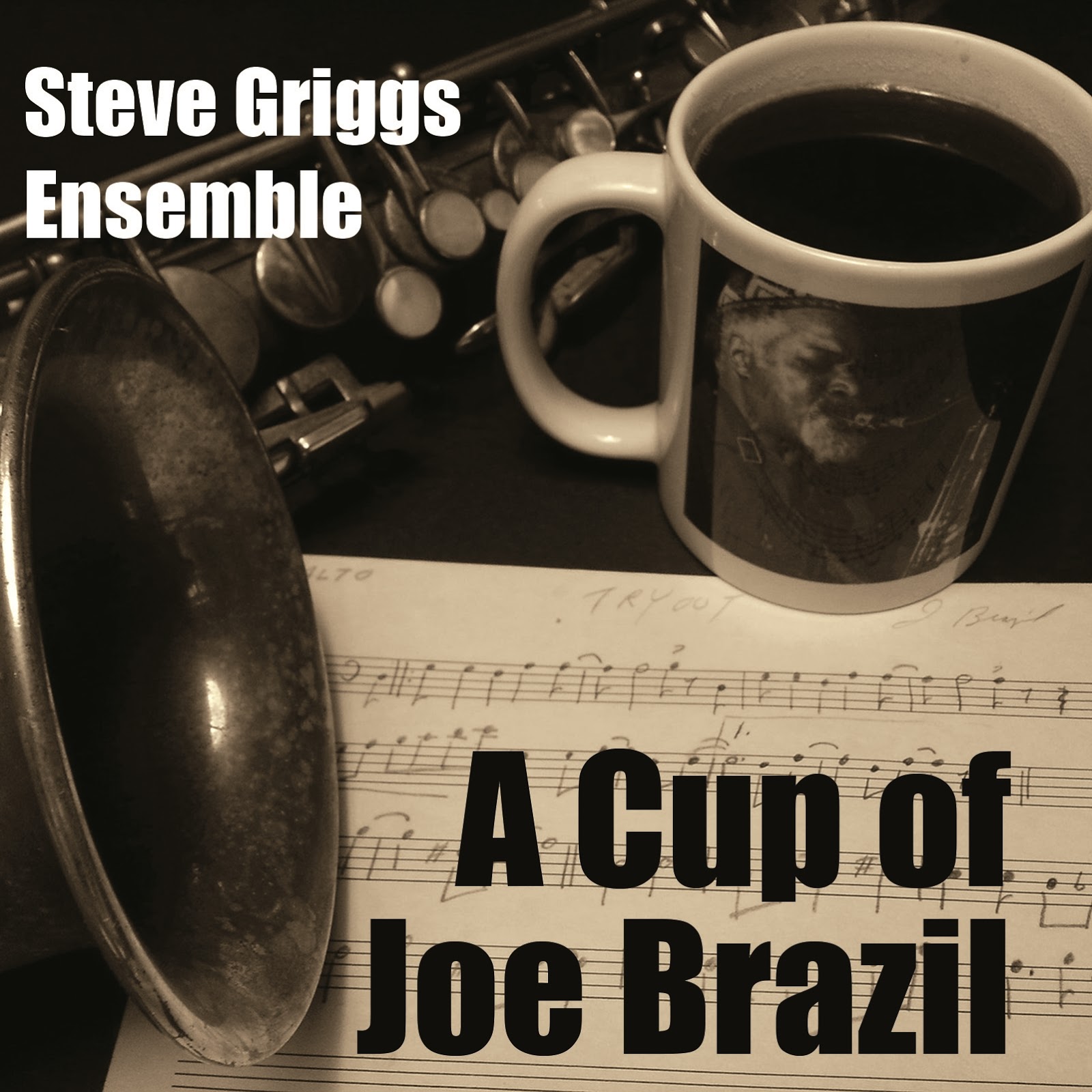
This is the overture to A Cup of Joe Brazil, an original program of stories and music about the Detroit-born saxophonist who taught jazz history at UW. Vibraphonist Susan Pascal's husband Dave worked in one of Joe's bands. Trumpeter Jay Thomas' first jam session was with Joe Brazil.

A Cup of Joe Brazil on Playback

You can listen to A Cup of Joe Brazil for free at the Seattle Public Library Playback site: https://playback.spl.org/albums/steve-griggs-ensemble-a-cup-of-joe-brazil

Lyrics to "Joseph Brazil"

I wrote lyrics to the first track on A Cup of Joe Brazil even though they were not recorded.

"Joseph Brazil, black music will show us to live and to love, not to kill.
Joseph Brazil, teaches us still - look for the truth and the search is the thrill.
No one stops you. No one tops you.
Joseph Brazil, black music will lift us to equal the king of the hill."

Press Release for "The Secret Life of John Chapman"

I have recently acquired an original press release from CBS that lists the cast of "The Secret Life of John Chapman." Joe Brazil plays the role of Boss.

Reggie Workman on Joe Brazil

During a panel discussion of A Love Supreme hosted by Bill T. Jones, bassist Reggie Workman told a story about Joe Brazil bringing a car full of books to a meeting on Black Culture. I plan to share more of this story soon. In the picture are (left to right) Bill T. Jones, Ashley Kahn, John Lewis, Reggie Workman. Photo by Yasuhiro Fujioka.

Free concert in Blanche Lavizzo Park

One day after Joe Brazil's 90th birthday we will celebrate with a free presentation of A Cup of Joe Brazil at 1pm August 26 in the Blanche Lavizzo Park amphitheater (2100 S. Jackson). The performance is sponsored by the Office of Arts & Culture Arts in the Parks Program.