|
| My tribute to Brazil's story |
But he is not the first dead musician to mentor me. First, was John Coltrane. He died in 1967, when I was seven. About 11 years after he died, I finally heard his music on a record and was entranced. The song that first got me was “Village Blues.”
[Band plays Village Blues quietly]
John Coltrane had been studying Spirituals - the simple melodies sung by slaves gathered in a circle after church services. The words spoke of hardship and freedom. Even though the subjects were often biblical, the meaning was personal – someday freedom will come. The rhythms were slow and repetitious, like the work songs used to row, dig, plant, and pick. They were chants that entranced the singer to give strength. The communal music could endure long hours, harsh conditions, brutal oppression. Spirituals fed the soul.
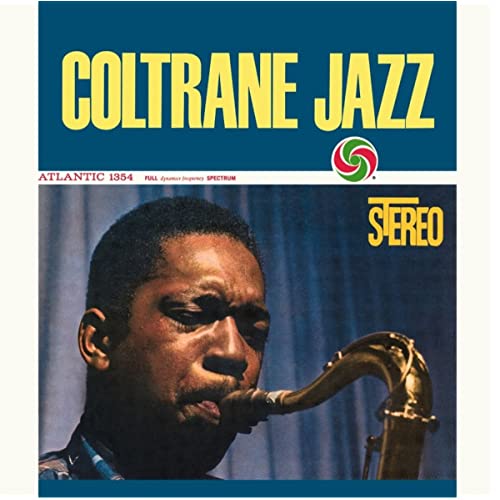 |
| "Village Blues" on Coltrane Jazz |
That sound caught my heart and became one of my favorite things. Although my psyche was naïve to the wound of slavery, the music embodying the human spirit that endured that oppression awakened empathy to those struggling for freedom. Under the spell of the sound, I would search all my life to get close to its source – and dedicate my life to music.
I listened to every Coltrane record I could find. I wanted to play music with that deep vibe, music that put you in a trance and evoked a weighty sincerity. The things that stood out to me were the sound of the whole band, that everyone played an equal part – supporting each other so that the music surpassed any individual talent, and that the sound was a musical abstraction of feelings, events, and people.
[Band stops]
So when I moved to Seattle, I wanted to find out about the time that Coltrane played here. Coltrane came to Seattle in 1965 to play a week at the Penthouse, a jazz club at the corner of 1st and Cherry. He paid out of his own pocket for a live recording at the club and another in a Lynnwood studio. The music sounded crazy. People were chanting, drums bashing, horns squealing. I couldn’t pick out any recognizable melody or form. It sounded like freedom – spirits unleashed. Emotive motifs turned up to 11!
There was one name on the record I had never heard before, Joe Brazil. Who was he? How did he get involved with Coltrane? What was he doing in Seattle? What was this music about? I was used to learning about famous musicians through lots of commercial recordings. Who was this obscure person? What could I learn from him? I made it my mission to find out.
 |
| Coltrane's cigarette burn on Brazil's low "A" |
But the story of Joe and Coltrane starts ten years earlier in Detroit. Before Motown, there were the roots of Rhythm and Blues, Boogaloo, and Jazz.
[Play Detroit]
1950’s Detroit was a hot bed of jazz. The best musicians from New York had to practice before traveling there because the level of skill in the bands at the local venues was so high. Like many Detroit musicians, Joe Brazil was working at an auto factory during the day. At night, he listened to records, practiced, hit the clubs, and sat in with some of the best artists in the world. He set up his basement with a piano and invited musicians to come over and jam. Joe’s basement was where local musicians rubbed elbows with the touring talent in all night sessions outside of public view.
 |
| The basement entrance to Brazil's Detroit home |
Shouts, chuckles, and grins erupt when the soloist shifts into a higher gear and breaks free of inhibition. You see, it takes courage to put your sound on display for other musicians. Another soloist demonstrates a new technique. Intense practice has added new language to the improviser’s vocabulary and the jam session is a chance to display wit and cleverness while using those words in a musical sentence. A third soloist finds in their instrument a deeper spiritual quality of the human voice that embraces the joyful pain of living. Tone is everything. It binds the listener and performer at the most intimate and primal level.
A tall man, more like a boy, hunches over the shoulder of an upright bass, glistening forehead turned to watch the spidery fingers of his left hand dance up, down, and across the web of four parallel strings. The tips of his calloused fingers scissor rapidly like an archer sending volleys of sonic arrows into the bulls-eye hearts of chords prancing out of the piano. Another musician prays over the keyboard, sweat dripping on the ivories; his hands jab at clusters of notes to illuminate the path of the music, pointing to alternate routes, encouraging, tantalizing, and teasing the soloist.
Behind the drums, a man stares at the ceiling, his mouth gaping, his right hand shaking a stick that jitterbugs across a cymbal. The soloist, a saxophonist, stands still, eyes fixed on infinity, ears awash in improvisation. He tastes the bamboo reed and metal mouthpiece, and fills the room with his breath, fingers tapping out the ancient code he heard on a Charlie Parker record. Everyone in earshot receives the message – this guy dug deep into the record grooves and is sharing the jewels with his community. Most understand. The novices on the stairs crease their brows to place the notes. Where have I heard that before? Where is he going with this? Did you hear what the piano player just said? Man, I need to go practice!
At the top of the chorus, the saxophonist punctuates his phrase and turns to the trumpet player to his right. Within seconds, the trumpet echoes the saxophonist’s phrase, twisting, deconstructing, re-assembling the idea to fit the morphing chords of the song. But his sound is lower, quieter, less agitated because that’s his nature. His spirit comes out through the bell of his horn. He is finding his voice.
That’s why you are here. You open your instrument case, put it together, and gently blow warm air through the horn.
The trumpet player meets your eyes to pass the baton.
[Play Bebop in the Basement]
A frequent visitor to Brazil’s basement was saxophonist John Coltrane. Coltrane would come to Detroit many times in the 1950’s with Miles Davis and want to practice during the day and after the gig. Miles’ bass player Paul Chambers had lived at Joe’s house before joining Miles’ band so Coltrane found out about Joe and started using Joe’s house as a place to work on music when he was in Detroit. By the time Coltrane was bringing his own band to Detroit, Coltrane skipped the hotel entirely and stayed at Joe’s house. Coltrane, Brazil, and a handful of other saxophonists would share ideas, practice, and learn together in an informal but serious setting. I think this casual but passionate and collective way of learning would serve as a model for Joe’s teaching style in the future.
 |
| The site of some recordings by Brazil |
He also taped jam sessions at his home. Joe left behind a trove of audio tapes that document an important chapter in the development of the music and musicians that went on to achieve legendary status. I hope that one day the public will be able to hear this candid and intimate sound of informal music making. Joe and the few people who have heard these tapes are no longer with us. In Joe’s tape collection, I found one box labeled 3am Thanksgiving 1960 with the names John Coltrane, McCoy Tyner, and others. Coltrane and his band were in Detroit that week and staying at Joe’s house. I let my imagination ponder how that could have sounded.
[Play Thanksgiving]
By the end of the 1950’s, industrial work slowed in Detroit. Joe spotted an advertisement on the factory bulletin board – Boeing in Seattle was hiring. Joe got a job as a tool and die maker and moved out just as Century 21, the Seattle World’s Fair, got underway.
The contrast between Detroit and Seattle was stark. Joe stayed at the Y downtown and when he looked out his window he said to himself, “Where are all the black people?” Seattle was and still is one of the whitest cities in America. Joe had to search for blacks here. In other American cities, musical community leaders had wider influence – Horace Tapscott in Los Angeles, Julius Hemphill in St. Louis, Muhal Richard Abrams in Chicago. But Joe had migrated to a city with a small black community, so his influence was constrained.
During the day, Joe worked in manufacturing and studied at the University of Washington – mostly math and computer programming. But he never abandoned music. At night, Joe led a jazz ensemble called the Jazz Souls.
[Play Jazz Souls]
 |
| Brazil plays Coltrane's African flute |
Some listeners, including myself, have thought the music sounded angry, chaotic, expressing pain. But Brazil explained in an interview that the musicians were trying to reach another level of consciousness, a state of exhilaration and joy, striving for a sound that would help people come together.
A few years later, Brazil collaborated on a piece called “Levels of Consciousness” where he improvised on saxophone while a dancer moved and an actor recited quotes of John Coltrane. Here is our version of Consciousness.
[Play Consciousness]
In 1967, Coltrane died and I imagine that Joe must have been devastated. I wonder if Coltrane’s death and Martin Luther King’s death the following year inspired Brazil to think about his own mortality. Coltrane was just a year older than Brazil and King was two years younger. This existential reckoning may have urged him to pass information on to the next generation. Joe began teaching music in Seattle schools – Seattle Community College, Washington Middle School, and Garfield High School. One friend of Joe’s told me, “Joe was a prophet. He wanted people to remember the old guys.”

Enrollment and attendance for Joe’s classes grew dramatically while interest in traditional classes at the School of Music shrank. But Joe’s pro-black stance alienated whites when, at Whitman College, he addressed an African American Cultural Festival with a lecture emphasizing the African ancestry of Beethoven and Haydn. But Joe wasn’t making it up. He had heard Stokley Carmichael say this years earlier at Garfield High School. And there were three books documenting the composers’ dark complexion and African facial features.
In his lecture, Joe went on to demand equality in teaching black music in schools. Joe said, “Americans are usually proud of their achievements. It is ironic; here is one of the most important cultural subjects, and we are not teaching it in a meaningful way. We teach the European music, but we should be pushing American music just as heavily. If you cancel out the music of the blacks, America would be culturally bankrupt.”
[Play Beethoven Was Black]
Joe was on the leading edge of introducing academia to the community and culture of Black America, but the white faculty did not welcome that change and did not grant Joe tenure. Given the rising class enrollment and access to outstanding artists as a unique benefit he brought to the job, Joe attributed the vote of no confidence to racism. An inside investigation did not find legal evidence to support Joe’s claim.
There was a definite lack of respect for Joe’s casual style and popular subject. Personality, story telling, casual adherence to schedules, mistrust of administration, expression of feelings related to oppression, and public airing of grievances – these did not fit the mold of the UW School of Music.
Brazil was replaced by Milton Stewart, a black professor from the University of Michigan. He was treated with even less respect than Brazil. When Stewart was denied tenure in 1982, he wrote to the NAACP. “They desperately wanted me because I was a black person with a Ph.D. in music who taught jazz and other Afro-American music courses. One of their ‘reasons’ for terminating Joe Brazil was that he didn’t have academic credentials. I was used as a foil to make what they were doing to Mr. Brazil appear legitimate.”
 |
| King Carl Gustof awards Brazil |
Around this same time that Joe was recognized by royalty, Brazil also appeared on a record by vibraphonist Roy Ayers. I decided to mix these two events into a song called “Royal Heirs.”
[Play Royal Heirs]
I found a single page of an autobiography Joe started but never finished. He wrote, “My life has taken a number of directions, but all seemingly with a purpose. Along the way I have come in contact with some remarkable people. Most have had some positive impact on my life. I have also come in contact with many racists and bigots.
“I feel the information that I share about my life may help to bring about some awareness that will bring us earthlings a step closer together.”
“Bring about some awareness.” That’s a message from Joe. When I contemplate Awareness and how to bring people closer together, this is how I think it sounds.
[Play Awareness]

Joe struggled for his whole life against racial discrimination. He grew up in a time when he was often the first black person where he lived and worked. And in the Pacific Northwest where blacks are marginalized, he repeatedly advocated for education and employment of blacks. If Brazil had lived in Los Angeles or New York City his impact would have been enormous.
Joe Brazil’s example and advocacy for social justice made a difference in the lives of many people. But, pioneers often encounter obstacles when blazing a new path. I am grateful for the trail Joe made and the struggles he shouldered. Joe was an important figure in the civil rights movement here in Seattle – one of America’s whitest cities.
James Baldwin said in 1963, “The obligation of anyone who thinks of himself as responsible is to examine society and to try and change it and to fight it—at no matter what the risk. This is the only hope society has. This is the only way societies change.”
[Play Hope]